Which of the Following Best Describes the Standard of Ur Art History
| The Standard of Ur | |
|---|---|
 "War" panel | |
| Material | shell, limestone, lapis lazuli, bitumen |
| Writing | cuneiform |
| Created | 2600 BC |
| Discovered | Regal Cemetery |
| Nowadays location | British Museum, London |
| Identification | 121201 Reg number:1928,1010.iii |
The Standard of Ur is a Sumerian artifact of the tertiary millennium BC that is now in the collection of the British Museum. It comprises a hollow wooden box measuring 21.59 centimetres (8.50 in) wide by 49.53 centimetres (nineteen.50 in) long, inlaid with a mosaic of shell, red limestone and lapis lazuli. Information technology comes from the ancient metropolis of Ur (located in modern-day Iraq west of Nasiriyah). It dates to the First Dynasty of Ur during the Early on Dynastic menses and is around four,600 years old. The standard was probably synthetic in the form of a hollow wooden box with scenes of war and peace represented on each side through elaborately inlaid mosaics. Although interpreted as a standard by its discoverer, its original purpose remains enigmatic. Information technology was establish in a royal tomb in Ur in the 1920s next to the skeleton of a ritually sacrificed homo who may have been its bearer.
History [edit]
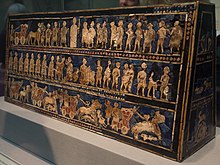
The Standard of Ur, in the British Museum.
The artifact was found in one of the largest regal tombs in the Purple Cemetery at Ur, tomb PG 779, associated with Ur-Pabilsag, a male monarch who died around 2550 BC.[one] Sir Leonard Woolley's excavations in Mesopotamia in 1927–28 uncovered the artifact in the corner of a chamber, lying shut to the shoulder of a man who may accept held it on a pole.[2] For this reason, Woolley interpreted it every bit a standard, giving the object its popular name, although subsequent investigation has failed to confirm this assumption.[3] The discovery was quite unexpected, as the tomb in which it occurred had been thoroughly plundered by robbers in ancient times. As ane corner of the last bedchamber was being cleared, a workman spotted a piece of shell inlay. Woolley afterwards recalled that "the adjacent minute the foreman'due south hand, carefully brushing away the earth, laid bare the corner of a mosaic in lapis lazuli and shell."[4]
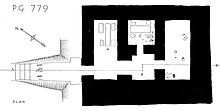
Plan of grave PG 779, thought to vest to Ur-Pabilsag. The Standard of Ur was located in "Due south"
The Standard of Ur survived in only a bitty status. The ravages of time over more than four thousand years caused the decay of the wooden frame and bitumen glue which had cemented the mosaics in place. The soil's weight crushed the object, fragmenting it and breaking its end panels.[ii] This made excavating the Standard a challenging task. Woolley'southward excavators were instructed to look for hollows in the ground created by decayed objects and to fill them with plaster or wax to tape the shape of the objects that had in one case filled them, rather like the famous plaster casts of the victims of Pompeii.[5] When the remains of the Standard were discovered by the excavators, they found that the mosaic pieces had kept their form in the soil, while their wooden frame had disintegrated. They carefully uncovered small sections measuring nigh 3 foursquare centimetres (0.47 sq in) and covered them with wax, enabling the mosaics to exist lifted while maintaining their original designs.[6]
Description [edit]

The nowadays course of the artifact is a reconstruction, presenting a all-time judge of its original appearance.[2] It has been interpreted every bit a hollow wooden box measuring 21.59 centimetres (8.l in) broad by 49.53 centimetres (19.50 in) long, inlaid with a mosaic of beat out, red limestone and lapis lazuli. The box has an irregular shape with cease pieces in the shape of truncated triangles, making information technology wider at the bottom than at the top, along the lines of a Toblerone bar.[3]
Inlaid mosaic panels encompass each long side of the Standard. Each presents a series of scenes displayed in three registers, upper, middle and lesser. The two mosaics have been dubbed "War" and "Peace" for their discipline matter, respectively a representation of a military campaign and scenes from a banquet. The panels at each end originally showed fantastical animals but they suffered significant damage while buried, though they have since been restored. Both sides use hierarchical proportion in the depiction of the forms of the fine art, with the most important individuals appearing larger than less important ones.
Mosaic scenes [edit]

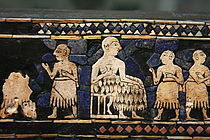
"Peace" item showing lyrist and possibly a vocaliser
"War" is one of the earliest representations of a Sumerian army, engaged in what is believed to exist a border skirmish and its aftermath. The "War" panel shows the king in the centre of the top annals, standing taller than whatever other effigy, with his head projecting out of the frame to emphasize his supreme status – a device also used on the other console. He stands in front of his bodyguard and a 4-wheeled wagon,[notation 1] drawn past a squad of some sort of equids (possibly onagers or domestic asses;[7] [8] horses were only introduced in the 2d millennium BC subsequently existence imported from Central Asia[ix]). He faces a row of prisoners, all of whom are portrayed as naked, bound and injured with large, bleeding gashes on their chests and thighs – a device indicating defeat and debasement.[3] In the middle register, eight virtually identically depicted soldiers give mode to a battle scene, followed past a depiction of enemies being captured and led away. The soldiers are shown wearing leather cloaks and helmets; actual examples of the sort of helmet depicted in the mosaic were plant in the same tomb.[5] The nudity of the captive and dead enemies was probably not meant to draw literally how they appeared in existent life, but was more than likely to accept been symbolic and associated with a Mesopotamian belief that linked death with nakedness.[10]
The lower register shows four wagons,[note 1] each carrying a driver and a warrior (conveying either a spear or an axe) and drawn by a team of four equids. The wagons are depicted in considerable detail; each has solid wheels (spoked wheels were not invented until about 1800 BC) and carries spare spears in a container at the forepart. The organisation of the equids' reins is besides shown in detail, illustrating how the Sumerians harnessed them without using $.25, which were simply introduced a millennium later.[5] The wagon scene evolves from left to correct in a manner that emphasizes motion and activity through changes in the delineation of the animals' gait. The commencement wagon team is shown walking, the second cantering, the third galloping and the fourth rearing. Trampled enemies are shown lying nether the hooves of the latter three groups, symbolizing the potency of a railroad vehicle attack.[iii]
"Peace" portrays a banquet scene. The king again appears in the upper register, sitting on a carved stool on the left-hand side. He is faced by six other seated participants, each holding a cup raised in his right hand. They are attended by various other figures including a long-haired individual, possibly a singer, who accompanies a lyrist. In the middle register, bald-headed figures wearing skirts with fringes parade animals, fish and other goods, perhaps bringing them to the feast. The bottom register shows a serial of figures dressed and coiffed in a dissimilar way from those above, carrying produce in shoulder bags or backpacks, or leading equids by ropes attached to nose rings.[3]
Interpretations [edit]
The original function of the Standard of Ur is not conclusively understood. Woolley's suggestion that information technology represented a standard is at present thought unlikely. It has also been speculated that information technology was the soundbox of a musical musical instrument.[2] Paola Villani suggests that information technology was used every bit a chest to store funds for warfare or civil and religious works.[eleven] It is, all the same, incommunicable to say for certain, as at that place is no inscription on the artifact to provide whatever background context.
Although the side mosaics are unremarkably referred to every bit the "war side" and "peace side", they may in fact be a unmarried narrative – a battle followed by a victory celebration. This would be a visual parallel with the literary device of merism, used past the Sumerians, in which the totality of a state of affairs was described through the pairing of contrary concepts.[12] [13] A Sumerian ruler was considered to have a dual role every bit a lugal (literally "big man" or war leader) and an en or civic/religious leader, responsible for mediating with the gods and maintaining the fecundity of the land. The Standard of Ur may have been intended to draw these ii complementary concepts of Sumerian kingship.[3]
| External media | |
|---|---|
 | |
| Audio | |
 The Standard of Ur plan as part of the BBC's 'A History of the World in 100 Objects' The Standard of Ur plan as part of the BBC's 'A History of the World in 100 Objects' | |
| Video | |
 The Standard of Ur, Smarthistory[14] The Standard of Ur, Smarthistory[14] |
The scenes depicted in the mosaics were reflected in the tombs where the "Standard" was institute. The skeletons of attendants and musicians were found accompanying the remains of the kings, as was equipment used in both the "War" and "Peace" scenes of the mosaics. Dissimilar ancient Egyptian tombs, the dead were not buried with provisions of food and serving equipment; instead, they were found with the remains of meals, such equally empty food vessels and brute bones. They may have participated in one terminal ritual feast, the remains of which were buried aslope them, earlier being put to death (possibly by poisoning) to back-trail their master in the afterlife.[fifteen]
See also [edit]
- Lyres of Ur
Notes [edit]
- ^ a b Anthony (2006, p. five): "Wagons have four wheels, carts have ii, and chariots have two spoked wheels, and so that the vehicles on the Ur Standard are wagons, not chariots, as they are often called."
References [edit]
- ^ Hamblin, William James. Warfare in the aboriginal Virtually East to 1600 BC: holy warriors at the dawn of history, p. 49. Taylor & Francis, 2006. ISBN 978-0-415-25588-2
- ^ a b c d The Standard of Ur, British Museum. Accessed 2010-12-05.
- ^ a b c d e f Zettler, Richard 50.; Horne, Lee; Hansen, Donald P.; Pittman, Holly. Treasures from the royal tombs of Ur, pp. 45-47. UPenn Museum of Archeology, 1998. ISBN 978-0-924171-54-3
- ^ Woolley, Leonard (1965). Excavations at Ur: a record of twelve years' piece of work. Crowell. p. 86.
- ^ a b c Collon, Dominique. Ancient Near Eastern Fine art, p. 65. University of California Press, 1995. ISBN 978-0-520-20307-5
- ^ Chadwick, Robert (1996). Kickoff Civilizations: Ancient Mesopotamia and Ancient Egypt. Editions Champ Fleury. ISBN9780969847113.
- ^ Clutton-Brock, Juliet (1992). Equus caballus Power: A History of the Horse and the Donkey in Man Societies. U.South.: Harvard University Printing. ISBN978-0-674-40646-9.
- ^ Anthony 2006, p. 5.
- ^ Gates, Charles (2003). Ancient Cities: The Archaeology of Urban Life in the Ancient Near Eastward and Egypt, Greece and Rome. Routledge. p. 48. ISBN9780415121828.
- ^ Bahrani, Zainab (2001). Women of Babylon: Gender and Representation in Mesopotamia. Routledge. p. threescore. ISBN9780415218306.
- ^ Settemila anni di strade. Milano: Edi-Cem. 2010.
- ^ Harrison, R.K. "Genesis", p. 441 in Bromiley, Geoffrey W. (ed.), International Standard Bible Encyclopedia: E-J. Wm. B. Eerdmans Publishing, 1982. ISBN 978-0-8028-3782-0
- ^ Kleiner, Fred Southward. Gardner's Art Through the Ages: The Western Perspective, p. 24. Cengage Learning, 2009. ISBN 978-0-495-57360-9
- ^ "The Standard of Ur". Smarthistory at Khan Academy. Retrieved March 27, 2013.
- ^ Cohen, Andrew C. Death rituals, ideology, and the development of early on Mesopotamian kingship: toward a new understanding of Republic of iraq's royal cemetery of Ur, p. 92. BRILL, 2005. ISBN 978-xc-04-14635-8
Sources [edit]
- Anthony, David W. (2006), "The Prehistory of Scythian Cavalry: The Development of Fighting on Horseback", in Aruz, Joan; Farkas, Ann; Valtz Fino, Elisabetta (eds.), The Golden Deer of Eurasia: Perspectives on the Steppe Nomads of the Aboriginal World, Metropolitan Museum of Art (New York, North.Y.)
External links [edit]
- Podcast of The Standard of Ur BBC Radio programme (mp3)
- What is the Standard of Ur?
Source: https://en.wikipedia.org/wiki/Standard_of_Ur
0 Response to "Which of the Following Best Describes the Standard of Ur Art History"
Post a Comment